A couple of things today:
First, I finally got my copy of cooking liberally in the mail from the divine SallyH - it is a collection of recipies submitted by the fine folks at Echaton and contains my famous recipie for "Sausage au Rev. Paperboy" formerly known as "Sausage au Kevin" or "Sausage a la Bernice" -- If you're nice and leave a comment, I'll post the recipie.
Second, Todd Snider rules for many reasons, one of them is that he wrote this song:
"Conservative Christian right-wing Republican
straight white American males,
Gay-bashing, black-fearing, war-fighting, tree-killing
regional leaders of sales,
Frat-housing, keg-tapping, shirt-tucking, backslapping
haters of hippies like me
Tree-hugging, peace-loving, pot-smoking, porn-watching
lazy-ass hippies like me
Tree-hugging, love-making, pro-choice and gay-wedding,
widespread digging hippies like me
Skin-color-blinded, conspiracy-minded
protestors of corporate greed
We who have nothing and probably will
until we all end up locked up in jail
by conservative Christian right-wing republican
straight white American males
Diamonds and dog, boys and girls
living together in two separate worlds
following leaders of mountains of shame
looking for someone to blame --I know who I like to blame
Conservative Christian right wing Republican
straight white Amurikin males
Soul-saving, flag-waving, Rush-loving, land-paving
personal friends of the Quayles
Quite dilligently, working so hard to keep the free
reins of this democracy
from tree-hugging, peace-loving, pot-smoking
folk-singing hippies like me"
for the musically minded - its in waltz time (3/4) and I think its in "G" (the people's key)
And finally, I'm going to see the new Harry Potter movie this afternoon. Yep, its hard work being a critic - hard, hard work.
Thursday, November 03, 2005


The smackdown
Dave Neiwert goes up one side of Michelle Malkin and down the other with a barbed-wire wrapped rod of correction and it couldn't happen to a nicer pathological liar.
Monday, October 31, 2005
GOP to workers: Go Cheney yourselves
This from the comments at Eschaton, the smartest, funniest and sexist bunch of moonbats in the blogosphere,( well except for Toby and Ruprect)
GOP Senate votes to keep wages below Depression era standards
Saturday, October 29, 2005
Tricks are the treat in Tokyo
Kevin Wood / Daily Yomiuri Staff Writer
With Halloween drawing near, thoughts turn to witches, sorcery, ghosts, and unexplained phenomena. What better way to put oneself in the mood for the holiday than with a little magic? Japan has its share of ghost stories, and fortune-tellers can be found on any corner. But tricks are the latest treat in Tokyo, home to a thriving community of illusionists, conjurors, prestidigitators and sleight-of-hand artists.
The nation is experiencing a magic boom with an increasing number of stage magicians appearing on television, and more and more tricks for amateurs appearing on department store and specialty shop shelves.
One such shop is Magic Land, near Hatchobori Station in Tokyo, an overflowing third-floor treasure trove of tricks, apparatuses and books that hosts lectures by visiting magicians and performances of close-up magic. Magic Land and its proprietor, Ton Onosaka, are the hub around which Tokyo's magic scene turns.
Onosaka, 72, has been practicing magic for about 60 years and opened the shop 25 years ago, around the time he retired from his day job with the Tokyo metropolitan government. Ton's wife, Setsuko, herself a formidable magician, and his son, Satoshi, take care of day-to-day operations while Ton applies his considerable talents to creating new tricks and keeping in touch with his far-flung network of magic practitioners.
The Onosakas attend magic conventions around the world. Ton was instrumental in helping produce the biggest international gatherings of magicians in Japan and is often called upon for advice on the production of television and stage shows. A gifted artist with a pencil as well as a wand, Onosaka has illustrated so many magic instruction books in Japan and abroad that he has lost count of the number.
With his gray beard and full, long, flowing hair, Onosaka looks like a Japanese version of Harry Potter's headmaster, Albus Dumbledore.
Speaking with The Daily Yomiuri days after returning from the inaugural conference of the Asia Magicians Association in Thailand, Onosaka brims with enthusiasm about the Tokyo magic scene.
"Magic is starting to sprout in Japan, it is really starting to grow," Onosaka says, pointing to the rising number of young hobbyists taking up the art, the proliferation of paraphernalia in non-specialty stores and the burgeoning magic bar and restaurant scene, with more than 20 such establishments in the greater Tokyo area.
Among the top venues in Tokyo is Usagiya. A traditional three-story structure tucked away next to Jodoji temple off busy Hitotsugi street in Akasaka, Usagiya features close-up magic shows in the first floor bar and restaurant at 7 p.m. and 9 p.m. for a relatively inexpensive 2,000 yen seating charge, and table magic in its second floor hostess club for an additional charge, with stage magic performed on Saturday nights.
Usagiya has a stable of about 12 professional magicians working in rotation, with two performers producing selected cards from unlikely places and lighting cigarettes with flaming wallets at tableside, but all the staff are ready and able to perform a few simple tricks of their own.
Ninja, next to the nearby Akasaka Excel Hotel Tokyu, offers table magic with dinner, as does Trattoria Gioia, one of several places in Ginza featuring magic entertainment.
Shingo, the in-house magician at Magic Bar Issey near Roppongi Crossing, says he prefers the younger crowds in Roppongi because they have a better sense of humor. Like Onosaka, he was bitten by the magic bug as boy when he saw a magician demonstrating tricks for sale in a department store. Now 22, he has been a working pro for three years.
One of the few resident foreign magicians in Tokyo, 40-year-old Steve Marshall, "The Ambassador of Magic from the USA," has been performing in Tokyo and across the country for seven years, including three years at Tokyo Disneyland and previous stints at Huis Ten Bosch theme park in Sasebo, Nagasaki Prefecture, and Disney World in Orlando, Fla. While he now most often performs at corporate events and VIP parties, he also enjoys doing occasional bar work.
"I love that bar environment. I love that close-up one-on-one because I get to see the amazement in their eyes, that moment of astonishment," said Marshall, a 20-year stage veteran.
Like Shingo, Marshall injects humor into his act, a product of his five years as a clown with the Ringling Bros. Circus in the United States and Japan. He often performs at the Tokyo Comedy Store (www.tokyocomedy.com) in both Japanese and English.
Marshall said he polishes his skills "anytime, anywhere," regularly drawing surprised smiles from shop clerks by making his change vanish. "I always have a deck of cards with me and usually a half dollar or some other coins and I'll practice moves sitting on the train," said Marshall, adding he often gets so focused on his rehearsals that he will suddenly look up to find all the other passengers staring at him in amazement.
Rising star Cyril is now working on his eighth two-hour TV special in Tokyo, to be aired in January, and plans to tour major hotels in Japan with a dinner show in December. Raised in Hollywood by his French-Moroccan mother and Okinawan father, Cyril got his first taste of magic at 7 when friends of his parents snuck him into a Las Vegas revue. He claims to remember only two things--the cavalcade of topless showgirls and the "sorcerer."
"I use the word 'sorcerer' because at the time, I knew nothing about tricks or secrets. Everything I witnessed that night was pure and true magic...The magic was such a real experience for me that I remember months of sleepless nights trying to stay up in bed trying to figure out how to move, vanish or transform a random object in my bedroom," Cyril said. "I didn't care about finding out Santa was not real, but when they told me that magic wasn't real, I just couldn't believe it. I was devastated."
Cyril says the resurgence of magic in Japan is good for performers artistically as well as commercially. "The [Japanese] audience is much more educated and knowledgeable in magic. This, of course, makes it more challenging to stimulate them. We, as magicians, must find new themes, techniques, methods, effects and magical approaches to keep our Nihonjin viewers in awe," he said.
Tokyo's professional prestidigitators are backed by a formidable crowd of dedicated part-timers and amateurs. Shigeru Tashiro is president of the Japan Close-Up Magicians Association (www.jcma.net) and one of the founders of Magic Circle Japan (MCJ), a loose affiliation of conjurors of all skill levels who meet monthly in Ikebukuro to swap illusions, show off their technique and teach younger hobbyists the tricks of the trade. Shigeru says the meetings draw between 40 and 60 people a month who pay a nominal fee to cover costs. To encourage younger attendees, meetings are free for those under 18.
Onosaka endorses MCJ's efforts, saying it's important for kids to find good teachers. More important is the sense of community such groups provide. Onosaka has spent most of his life in the brotherhood of magicians and has friends scattered across the globe. He says his specialty isn't card tricks or pulling rabbits from hats--it's making "magic friends."
(The Daily Yomiuri Oct. 29, 2005)
Thursday, October 27, 2005
Fun and games
While Dubya fumbles with his SCOTUS nomination, and we wait to see who the special counsel indicts (Libby for sure, Rove is 50/50 and lots of small fish including Judy Miller for perjury) we might as well while away the hours trying to give President Bush a brain and enjoying some of his wit and wisdom.
Wednesday, October 26, 2005
That sound you hear is Joe Pulitzer spinning in his grave
Via Ripley's Zen Cabin from Associated Press, we learn that Pravda has moved to New Jersey
NEWARK, N.J. (AP) – Call it pay for praise, greenbacks for good news, bucks for beneficial publicity. The Newark City Council has awarded the Newark Weekly News a $100,000 no-bid contract to publish positive news about the city.
Check the links for the full story. I don't care if this is just the local freebie shopper - it is just SO wrong on so many levels to have the word "news" in the name of this publication after a deal like this has been made should have anyone who has ever worked in the media, hell, anyone who has ever read a newspaper, headed to Newark with pitchforks and torches in hand.
Monday, October 24, 2005
Dave Neiwert interview
A long posting, but since the Strawberry Days review had to be limited in length, I couldn't include all the great comments I got from Dave in our e-mail exchange. With that in mind here is some raw journalism (Yes, here in The Woodshed, we report and you decide) - my email Q&A with the proprieter of the blog Orcinus (see blogroll) and most recently, the author of Strawberry Days.
What made you want to turn your earlier newspaper work on the internment into a book, and why now?
David Neiwert: Actually, I had worked steadily, if intermittently, on this project as a book ever since I finished up the newspaper series back in 1992. I thought then that it was worthy of a book, and it was actually the first full manuscript I ever produced. I had it peer-reviewed by historians, though, and the results sent me back to the drawing board, with good cause. So, in between other book projects that seemed more current and thus more pressing time-wise, I kept conducting interviews and performing research on it up through last year, even as I was applying finishing touches. But there's no doubt that 9/11 gave the subject fresh urgency, and let me put things into sharper focus.
You discuss the racist anti-Asian and specifically anti-Japanese movements that arose in the 1920's and 1930's, how mainstream were these groups and to what extent was the internment a continuation of those movements?
These groups were really as mainstream as could be. White supremacism was part of the cultural air that Americans breathed back then. The campaigns emanated from the core of power politics, i.e., both the moneyed and the working classes. And there was a clear connection between those campaigns [which, incidentally, were mostly between 1910 and 1924] and the internment; many of the same figures emerged to promote internment (Miller Freeman being a classic case), and nearly identical arguments were heard throughout, especially those that painted a portrait of Japanese Americans as likely traitors.
Did internees from places other than the Bellevue area face similar problems returning to their former lives when the internment ended?
Yes; I discuss this in Chapter 6. Essentially, the Bellevue experience was replicated in small Nikkei farming communities up and down the coast -- the farmers had great difficulty owning their property, and the large portion of their reclaimed and largely leased lands had, during the war, become much more valuable for their white owners as potential developments for suburban neighborhoods. Something in excess of 60 percent of the internees were involved in farming before the war; after the war, less than 20 percent were able to return to those occupations. Most found work in urban manufacturing and services.
Was the evacuation and internment of Japanese done across the country or was it limited to the West Coast?
Strictly the West Coast, which comprised the entirety of Gen. DeWitt's "exclusion zones."
In Strawberry Days you write at some length about the role of Japanese truck farmers in the 1930s and 1940s in larger national agricultural picture. To what extent did the internment and effective confiscation of their farms push Japanese-Americans out of agriculture and into a more white collar or at least urban socioeconomic strata?
To a very large extent. (See the answer to the above question about internees from other places.) Though I would describe it more as "forced abandonment" than "effective confiscation," because it was rare that anyone took over their farms for agricultural uses. Mostly they went fallow. But this was part of the historical pattern of transiency that had been forced on Japanese Americans, which meant that they always remained flexible.
Most of the Issei came from rural prefectures and initially took up railroad and cannery work upon arrival, and then found ways to get back to farming, which they knew best. But even then, they moved constantly, forced (through the alien land laws, mostly) into a pattern of short residency on small tracts that they cleared and, typically, turned from marginal lands to productive and habitable properties.
Another important factor in all this was the respective ages of the Issei and the Nisei during the internment years. Most of the Issei were becoming elderly by 1942; nearly all of them, after all, had arrived before 1924, when all Japanese immigration was cut off. Most of the Nisei were in their teens and early 20s, so that by the time the war was over, many of them had taken over as chief breadwinners for their families. Most were better educated than their parents, and with a return to their former farms largely foreclosed as a possibility, they rather readily adapted to moving into an urban lifestyle.
Is the internment still a sore spot for Americans outside the Japanese-American community? Is it still a sore point in Bellevue? Should it be?
Only for those who are actually aware of it. In the readings I've done, and my subsequent interactions with the audiences, I've been kind of astonished by just how astonished everyone else is about all this, especially a lot of the history regarding the racist treatment of the Japanese immigrants (some people can't believe we denied them the right to naturalize prior to 1952).
Of course, I had something of an advantage: My parents grew up in Twin Falls, the "big town" nearest to the Minidoka camp, and I had gone pheasant hunting at the camp site when I was a boy; so I knew about this episode early on; and later, I had a Japanese American classmate with whom I was close whose father had been an internee. But I realized much later that we were taught nothing about the episode in our public-school history classes.
What kind of education about the internment is provided in the U.S. school system and do you think it is sufficient?
Well, I understand that discussion of the internment is included in some public-school curricula, but I don't think it's terribly widespread. It's often viewed, I think, as a minor incident in the war. But its significant long-term ramifications have become crystal clear in the past four years, I think, and because of that, I think some information about the internment should be a standard part of high-school history teaching on World War II. In our currently conservative and jingoistic environment, I don't know if that's going to take place.
What attracted you to this issue initially?
Well, it kind of started when I was working as the news editor for the little paper in Kent, WA, in 1990, and wandered into the White River Historical Museum in neighboring Auburn one rainy afternoon. They had a wall there of photos from the Minidoka camp, which set off all kinds of memories for me, since I knew that landscape well. I realized we were coming up on the 50th anniversary of the internment, and thought it would be a good project for the paper to write about.
So I started digging around into the local story there. A little while later I was transferred up to the Bellevue paper, where I was also news editor, and I decided to keep digging, but from the Bellevue angle. The story of the Bellevue community was, I realized, in some important ways more interesting and more telling in several regards, not least of which was the presence of Miller Freeman and his major role in the history of the community.
So I took off from there and produced a nice series for the paper that ran in May 1992. But when I was done, I wanted to do more with the story ... and eventually, I did.
What makes the issue of internment a timely one today?
Well, a lot of things. First is the overarching lesson of the internment: That Americans, in times of great national stress, were willing to completely discard the rights of our fellow citizens -- so long as it wasn't us. We also were willing to assume that race or ethnicity itself was cause to suspect others of treason.
I don't think these propensities have gone away; in fact, they've been resurfacing a lot since 9/11.Structurally speaking, the most important lesson of the internment is that the entire episode was sanctioned within the halls of power for one primary reason: it gave the military the precedent it sought to enable it to arrest and detain civilians in a non-battlefield situation without any recourse to the courts. That precedent has come back to us in the form of military tribunals and "enemy combatant status" instituted by the Bush administration since 9/11.
I like to remind my audiences of Justice Jackson's famous dissent in Korematsu (the infamous Supreme Court ruling that placed an official seal of approval on the evacuation), in which he described the precedent set by the internment as "a loaded gun" that could be turned on the rest of the populace at any given time. That warning, I say, has now come home to roost.
Could this sort of thing - the United States government imprisoning an entire class of its own citizens on the basis of race, religion or ancestry - be repeated or did the combination of accepted notions about race at the time, the hysteria after the sudden attack on Pearl Harbour, the depression and the push for internment from long-existing fringe groups produce a sort of "perfect storm", an ideal environment for the internment?
Oh, I think it could be easily repeated, given that the fear levels in America become high enough. More terrorist attacks would definitely make it possible.
In your previous books you've written a lot about hate groups and the militant right-wing fringe, what attracted you to these issues?
Well, what I really like to write about is the Pacific Northwest, and I am attracted to social-justice issues. And you know, I have some deep background in dealing with the matter of white supremacism, which includes some knowledge of its history, and that certainly was useful in giving the book a special edge. (A concomitant familiarity with conspiracy theories was especially useeful.)
But there is a thread running through all of my work so far, including my last book, which was about hate crimes: they all deal, in one shape or another, with eliminationism.I've studied fascism a great deal and have come to the conclusion that eliminationism is a signal marker of that particular pathology, since it encompasses so much of its core traits. It's been present in American history throughout: the Indian genocide, the Klan, lynching, the internment. And it's still with us today in the form of hate crimes -- not to mention, of course, the growing tide of eiliminationist rhetoric directed at liberals and war dissenters by the mainstream right, which so far has largely remained in the realm of words and not action. So far.
In the end, though, what really attracted me to this was that I see storytelling as a writer's greatest calling, and this was a great story.
Tell me a bit about your thoughts on blogs. Your website is a popular one, especially among progressive bloggers, what the appeal of doing a regular blog? Do you think they have much impact on politics and public in general or are they largely an echo chamber?
I write a blog for a couple of reasons:-- I'm a stay-at-home father now and don't have the constant buzz of a newsroom to keep me writing as well as tied in to the flow of information, so a blog gives me a reason to keep up my writing disciplne, work out writing ideas, and keep myself in the flow of current events.-- I'm an old editorialist without a mainstream outlet. A blog gives me one. And they are a terrific way of doing so and still finding an audience.
I do think that mainstream media has allowed its traditional role as a filter of bad information to become a bottleneck instead, so that information that should be getting disseminated isn't. Editors have too many preset agendas now and operate on the basis of their own preconceptions too much.So blogs kind of represent a market-of-ideas response to this bottleneck: they're a way of getting information disseminated that bypasses those filters. In fact, I think the function that bloggers most closely replicate (and thus eventually may supersede) is not that of the journalist but that of the editor.This can be good and bad, obviously; the removal of the filters has meant that a lot of bad information is now being disseminated as well. And I think the much-touted "self-correcting nature of the blogosphere" is mostly a sham. But there's little doubt that the fresh flow of information created by blogs has affected the political world in important ways.
So it's a wild and woolly media world we face now, and I really have no idea how it will all shake out. But it's definitely fun being involved.
What is your latest project on orcas all about?
Well, as I said, I like to write about the Northwest, and the orcas are perhaps the most fascinating of all the many creatures were cohabitate with here. But we are at real risk of losing them, for reasons that are closely connected to the environmental degradation of Puget Sound. There is a political component to that issue which I intend to explore in depth, though I also want to write in depth about the nature of the killer whale as well.
And finally - not that I want to start a slanging match or anything but is Michelle Malkin nuts, brain-damaged, just plain deluded or what?
She is a crass opportunist peddling a fraud, that's all.
Objective vs. Subjective
The good Dr. Berube has some interesting, if somewhat complex thoughts on the subject (or is it object?) And hey, anyone with a picture of the Hanson brothers on an academic blog is okay in my book.
Saturday, October 22, 2005
Record of a community destroyed
Kevin Wood / Daily Yomiuri Staff Writer
Dec. 7, 1941, is a day that will live in infamy for more than just the attack on Pearl Harbor. The events of that day, coupled with racist sentiments long existing in U.S. society, led to a dark chapter in that nation's history: The internment of an entire community of U.S. citizens for no other reason than their ancestry.
David Neiwert's Strawberry Days (Palgrave Macmillan, 280 pp, 29.95 dollars) is an examination of the internment of Japanese and Americans of Japanese descent on the U.S. West Coast. In the book, Neiwert combines extensive historical research--hundreds of primary and secondary source documents and broad-ranging interviews with numerous internees--to trace the history of the Japanese-American community in the town of Bellevue, Wash., a former farming community that is now a suburb of Seattle.
In an e-mail exchange with The Daily Yomiuri, Neiwert explained that Strawberry Days grew out a series of articles he wrote as news editor of the Bellevue Journal-American on the long-term effects of the internment on the local Japanese community.
Strawberry Days is really three books in one: A detailed historical chronicle of the whos, whats, wheres, whens and hows of the internment and the events leading up to it; a series of personal anecdotes and emotional reminiscences from internees and those who knew them; and an insightful, well-reasoned analysis of why the internment happened and what its ramifications are.
Neiwert tracks the history of Japanese immigration to the United States beginning in 1884, just two years after Chinese immigrants had been barred. The first came mostly to work in the Hawaiian sugar industry, later moving to work on rail gangs and in sawmills and canneries in places like Washington. The number of Japanese living in the United States swelled rapidly from about 2,000 in 1890 to more than 24,000 in 1910, according to census figures quoted in the book.
Most of the Japanese immigrants came from rural prefectures, and by the turn of the century many were working in local farm fields. In some areas, including Bellevue, issei and nisei leased or even bought land that they cleared and started truck farms on.
Just as with the Chinese decades earlier, the Japanese immigrants became the target of racist campaigns up and down the coast, led in the Seattle area by Miller Freeman, a publisher and businessman who later became a key figure in Bellevue. Neiwert catalogues various anti-Japanese campaigns including a 1906 move by the San Francisco school board which, under pressure from the Asiatic Exclusion League, ordered all Japanese students to attend the city's Chinese-only school, a slight that led to U.S.-Japanese saber-rattling that resulted in a de facto ban on immigration from Japan.
Miller's role in whipping up anti-Japanese sentiment dated back to as early as 1904 as a proponent of the "Yellow Peril" conspiracy theory, which held that Japanese immigrants had been sent to the United States as secret shock troops and spies for a coming invasion, a theory that was given much credence by those calling for internment years later. Miller continued to lead his Anti-Japanese League, wielding significant political clout in Seattle and pressing successfully for anti-Japanese legislation.
"These groups were really as mainstream as could be. White supremacism was part of the cultural air that Americans breathed back then. The campaigns emanated from the core of power politics, i.e., both the moneyed and the working classes. And there was a clear connection between those campaigns and the internment; many of the same figures emerged to promote internment--Miller Freeman being a classic case--and nearly identical arguments were heard throughout, especially those that painted a portrait of Japanese-Americans as likely traitors," Neiwert told The Daily Yomiuri.
Despite all this, Bellevue's Japanese community thrived. Specializing in strawberries, they were so successful that by the 1930s Bellevue's annual June strawberry festival was attracting 15,000 visitors to the town of fewer than 2,000 residents. The Japanese truck farmers there formed a very successful farming cooperative and community association and their berries were shipped all over the country from their own rail siding. Times were good.
With the coming of war, all this changed. Japanese-Americans were hounded from jobs and constantly suspected of espionage in the wave of hysteria following Pearl Harbor. Worse followed in the actions and attitude of Lt. Gen. John DeWitt, commander of the West Coast defenses who called for Japanese, citizens and immigrants alike, to be removed from the region. In May 1942, Bellevue's entire Japanese population--about 60 families comprising more than 300 people--were evacuated and interned along with about 120,000 other nisei, more than two-thirds of them U.S. citizens by birth. Most lost any personal possessions they couldn't carry.
Strawberry Days most harrowing chapters deal with internees' personal experiences of the evacuation and early period of internment. The most heartbreaking deal with their return after the war to find the farms they had been forced to abandon overgrown or sold for development. In Bellevue, one of the major developers was Freeman.
In one wrenching anecdote, Neiwert relates the story of Kiyo Yabuki, a Bellevue native who volunteered for the U.S. Army while interned and was badly wounded in France serving with the highly decorated 442nd Regimental Combat Team during the nisei unit's famous rescue of the so-called Lost Battalion. After spending most of a year in Vancouver, Wash., hospital, Yabuki took his army uniform to a Bellevue laundry for dry-cleaning. The shop refused to serve him because he was Japanese.
To Neiwert, the historical issue is still a timely one for a number of reasons: "First is the overarching lesson of the internment: That Americans, in times of great national stress, were willing to completely discard the rights of our fellow citizens--so long as it wasn't us. We also were willing to assume that race or ethnicity itself was cause to suspect others of treason. I don't think these propensities have gone away; in fact, they've been resurfacing a lot since 9/11...[the internment] gave the military the precedent it sought to enable it to arrest and detain civilians in a non-battlefield situation without any recourse to the courts. That precedent has come back to us in the form of military tribunals and 'enemy combatant status' instituted by the Bush administration since 9/11."
When the U.S. Supreme Court gave the constitutional seal of approval to the internment in its notorious Korematsu vs United States decision (in which U.S. citizen Fred Korematsu unsuccessfully appealed his conviction for the "crime" of refusing to leave his home), Justice Robert Jackson wrote in dissent that the precedent was "a loaded gun" that could be turned on the rest of the populace at any time.
"That warning, " says Neiwert, "has now come home to roost."
Thursday, October 20, 2005
Operation Enduring Blogger
Canadian current affairs uber-comic Rick Mercer (This Hour has 22 minutes, Monday Report) has done some great stuff over the years - getting Pierre Berton to show us how to roll a joint, having Margret Atwood demonstrate how to keep goal in the NHL - now he's gone to visit Canadian troops in Afghanistan with Guy Lafleur
Wednesday, October 19, 2005
In your ear
Kevin Wood / Daily Yomiuri Staff Writer
Paul Weller
As Is Now
V2 Japan, 2,520 yen
As the driving force behind the Jam in the late '70s and early '80s Paul Weller inspired many musicians who went on to form the core of the Britpop scene in the '90s.
As Is Now has Weller painting in bold strokes from his broad palette of stylistic colors, from the white-boy funk/rock of "Blink and You'll Miss it" to the acoustic Led Zepplinesque hippie pastoral of "All on a Misty Morning." While those tunes represent the stylistic extremes of the album, Weller is at his best when wearing his '60s British invasion and soul influences on his sleeve, summoning up the ghosts of the Kinks and the Who on rockers like "Come On/Let's Go" and "From the Floorboards Up" and echoing Small Faces on "Paper Smile."
Recorded mainly live off the studio floor over a couple of weeks in the spring, As Is Now has a cohesive sound that bodes well for any tour plans. The production and arrangements have a very '70s commercial pop feel with fat dixieland horns on the melodic piano-driven "Here's the Good News," a song that sounds like one of the better outtakes from an early Wings album.
On the other hand, the sweet strings and backing vocals on the ponderous "Pan" make it sound like a Spinal Tap leftover. Weller's fondness for jazzy soul and funk is admirable, but the seven-minute "Bring Back the Funk" makes one long for George Clinton and makes a compelling case for long jail sentences for anyone not from the American South who uses "y'all" unironically.
Despite these occasional overreaches, the quality of the songs and the performances are of a fairly high standard. Weller shows he still has the songwriting chops and voice that made the Jam one of the most popular bands of the early '80s. While composed entirely of new material, As Is Now sounds like a collection of hit singles and B-sides that span Weller's 30-year career in pop music.
Cream
Royal Albert Hall, London May 2-3-5-6, 2005
Warner Music Japan,
3,480 yen
Seminal power trio Cream reunited for four concerts at London's Royal Albert Hall in early May, 37 years after Eric Clapton, Jack Bruce and Ginger Baker played their final show together there.
The result is an excellent live double CD that puts the classic in classic rock. Cream dust off the classic blues tunes, like "Spoonful" and "Crossroads," that they helped repopularize back in the day, along with milestone originals such as "Badge," "Sunshine of Your Love" and "White Room."
Producing four albums from their formation in 1966 to their breakup in 1968, Cream, along with contemporary Jimi Hendrix, largely invented the blues-drenched genre of heavy rock and ushered in the era of long jams and virtuoso playing in pop music, making an international star of Clapton in the process.
Their reunion album shows that all three have come through the fires of the last four decades with their impressive talents intact. Baker may be over 60, but his lengthy drum solo on "Toad" shows he can still thrash the skins with the best. Bruce's voice has lost a little range in the upper register, but still has plenty of power and an almost operatic timbre. And the other guy hasn't played with this kind of verve in years.
A studio album of new material from this trio of similar quality just might qualify as the second coming of Clapton.
(Oct. 20, 2005)
Bridges' brilliance lifts melancholy Irving adaptation
Kevin Wood / Daily Yomiuri Staff Writer
The Door in the Floor
Three and half stars out of five
Dir: Tod Williams
Cast: Jeff Bridges, Kim Basinger, John Foster, Elle Fanning
The Door in the Floor is a European art film masquerading as a Hollywood melodrama.
It has all the elements loved by Hollywood studios: a big-name cast, complete with a doe-eyed child actor; a script adapted from a bestseller by a famous author; wealthy WASPs cavorting in an exclusive resort area; and plenty of sex and death. The catch is that none of the characters are very likable, the script only covers the first third of the book it is taken from, the resort is East Hampton, N.Y., instead of some exotic tropical paradise, the sex is sad, not steamy, and the deaths are tragic and offstage rather than showy action-movie slaughter.
The result is a complex and melancholy film more likely to please fans of Ingmar Bergman than Jerry Bruckheimer.
Jeff Bridges gives a detailed, layered and often subtle performance as failed novelist and successful children's author and illustrator Ted Cole, while Kim Basinger proves her Oscar for L.A. Confidential was not a fluke. She is nearly note perfect as Ted's wife, Marion, a fading beauty so paralyzed by sadness over the deaths of her teenage sons years earlier in a car wreck that she is incapable of caring for her 4-year-old daughter, Ruth (Elle Fanning, younger sister of the omnipresent Dakota).
The book the film is based on, John Irving's A Widow For One Year, is Ruth's story, and her childhood is only a small part of the novel. Director Tod Williams, who also wrote the screenplay, has switched the focus from Ruth to her parents and 17-year-old Eddie O'Hare, an aspiring writer that Ted has taken on as an assistant for the summer at the behest of his sons' alma mater.
Ted has coped with his son's deaths by drinking more and more and increasingly by philandering--using his fame to talk local women into posing as life models for him to paint and then seducing them. As Ted's affairs continue, his drawings become more and more degrading, until his portraits of his mistresses degenerate into crude renderings of their genitals.
It is an open question whether Ted is simply a misogynistic rat or whether his cheating and loathing of both himself and his lovers is a reaction to Marion's withdrawal from the world.
When Ted suggests a trial separation in which the couple will alternate days at the house, Marion wearily agrees.
Eddie develops an instant crush on Marion, awakening feelings in her both sexual and maternal. The graphic sex scenes between the two are shocking for their cold, matter-of-fact lack of eroticism and for their sadness.
Ted uses these feelings to his own selfish advantage, pushing the two together and then using their affair to gain leverage over Marion in their undeclared marital war of wills. Ted, though fearful of breaking with the past, wants to move on with life, whereas Marion is trapped in the past, unable to see a way forward without her sons.
For all his self-indulgence and drunken womanizing, Ted is a good father to Ruth and there is a sympathetic side to his character that shows through as he tells Eddie about the death of his sons and when we see him comforting Ruth when she wakes in the night. He uses Eddie and trashes the teen's attempts at writing, but all the while seems to take pains to protect and teach him.
This being a John Irving story, the pervasive gloom is leavened with humor, often at the oddest moments, such as Ted mistakenly adding the frozen squid ink he uses for his illustrations to his scotch instead of ice during one of the film's more somber scenes.
Bridges fully inhabits the loose-living Ted, even providing the illustrations for his character's Freudian children's books. The Door in the Floor is worth seeing for his brilliant performance alone. A lesser actor would have spoiled the film by trying to make Ted more of a likeable rogue, but Bridges isn't afraid to let the character's darker side show, sketching him as a vicarious philanderer who inhabits a moral universe of deep shades of gray instead of Hollywood's usual black and white.
The movie opens in Japan on Oct. 22.
Monday, October 17, 2005
Smoke'em if you got'em
Now we learn the pernicious weed may inhibit cancer
Just say Mo'
Study shows pot helps grow brain cells, improves memory. Hell, the next thing you know, scientists will be telling us that whisky is good for the liver.
Friday, October 14, 2005
RIP Theodore Roosevelt Heller of Chicago, who asked we send acerbic letters to Republicans instead of flowers.
Thursday, October 13, 2005
All schedenfreude, all the time
The imminent flameout of the Bush junta is much on my mind these days. It's been quite a while since I've watched the news or picked up a newspaper with such anticipation of rain of shit that is about to fall on some deserving heads Its not just the Plame case, or the day of reckoning for Tom Delay in the ever widening Jack Abramoff shitstorm or the Bill Frist insider trading charges that are bound to be coming soon, its the cumulative effect of all of these along with the rethuglicans plummeting poll numbers and the hints of the U.S. mass media regrowing its collective spine as they smell blood in the water. With his blinking and twitching Dubya's looked like Capt. Queeg on crystal meth in his interview on NBC as he pretended to build houses for the poor. Obviously the strain is starting to tell.
Sweet.
Wednesday, October 12, 2005
Pickin' and grinnin'
Kevin Wood / Daily Yomiuri Staff Writer
Guitar: An American Life
By Tim Brookes
Read by Tim Brookes
Blackstone Audio Books
11 1/2 hours on 9 CDs, unabridged
Sometimes we owe debts of gratitude for the oddest reasons. Author and "semiprofessional" guitarist Tim Brookes owes a great deal to the anonymous baggage handlers who mangled his most cherished possession. When his unknown benefactors managed to snap the headstock off the beloved Fylde guitar he had owned for 22 years, just months before Brookes' 50th birthday, his wife offered to buy him, within certain budgetary limits, any guitar he wanted as a birthday gift.
The promise launched Brookes on the dual quests that make up Guitar: An American Life.
The first is a chronicle of his search for the guitar of his dreams. Brookes tries out all the guitars in dozens of shops, coming to the realization that guitar shopping is the one time that men shop like women, going into stores and trying everything on with no serious intention of buying anything.
He decides to look for a custom-made guitar and after a brief search hooks up with luthier Rick Davis of Running Dog Guitars. Brookes follows Davis through every step of the guitar making process, exploring in depth the ins-and-outs of wood selection, design, shaping and finishing.
Such a close look at guitar making has the potential to bore senseless any but the serious guitar aficionado, however, Brookes makes it fascinating.
Between steps in the construction of the author's dream cherry-wood flattop, he pursues his second quest, compiling for the reader an extensive history of the instrument from its origins in Arabia to its arrival in America in the hands of Spanish soldiers.
Brookes traces the evolution of the guitar from its days as a ladies parlor instrument to its vital role in the creation of modern American music.
This second thread of Guitar takes an anecdotal approach to examining how the instrument has shaped and been shaped by North American pop culture. Brookes attends guitar conventions, talks to collectors, musicians, and cultural historians to present a wide-ranging look at the most popular, most widely played instrument in the world.
A seasoned radio presenter who regularly contributes to National Public Radio's Weekend Edition in the United States, Brookes wry take on his subject is never over-serious, though his passion for it is clear.
At times, the audiobook seems like a long radio documentary and you expect to hear those interviewed speaking for themselves.
The only disappointment is that after hearing so much about the building of Brookes' guitar, we never get to hear him play it.
(Oct. 7, 2005)
Sunday, October 09, 2005
Another one for the good guys
What do the Toronto Maple Leafs have that the Montreal Canadiens don't?
Black and white photos of their last Stanley Cup win.
While the Habs have Red Fisher
Saturday, October 08, 2005

A first world democracy with third world religiousity and problems
An interesting radio piece from the Australian Broadcasting Company, courtesy of fellow DY hack Jane O'Dwyer, soon to be departing our office and Nippon's fair shores to head up PR at Australia's National University,
and yes she is going to hate that picture and the link.
Summary
A discussion with researcher Gregory Paul, about his world-first study of data from the developed democratic countries in which he found a clear relationship between high levels of religious belief and practice, and social problems.
He finds the United States - the most religious of the western democracies, indeed the only strongly Christian nation remaining among the advanced democracies - does not emerge well ...
'Exceptionally Christian and anti-evolution America performs unusually poorly
in terms of rates of homicide, juvenile and adult mortality, STD infections,
abortion, and teen pregnancy and birth. America is the only first world nation to retain second and third world rates of religious belief and practice and disbelief in evolution, and is the only first world nation to retain second and third world rates of societal dysfunction.'
Tune in here to listen, just scroll down to Tuesday Oct. 4 and pick your media or download the MP3
Friday, October 07, 2005

Flashback
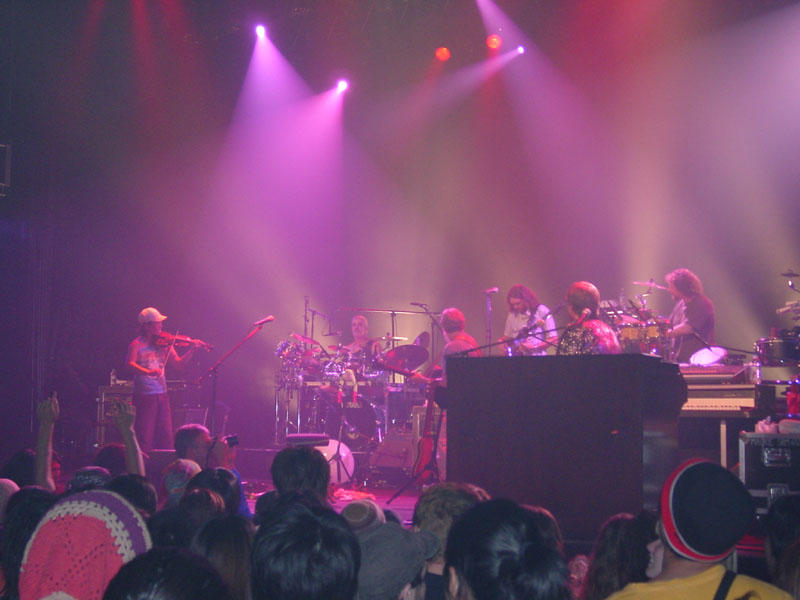
I went to see the String Cheese Incident last week (special thanks to Doug at Buffalo Records, purveyor of fine roots music, for squeezing me onto the guest list) and met a couple of guys from San Francisco who were here on business and took some great shots of the band and Tokyo in general. The rest of Evan and Michael's photos of Tokyo, including the requiste shots of school girls in Shibuya can be found here.
Doug's excellent photos can be seen on his new bilingual blog




 Posts
Posts


